

Sex Doll Material Safety: What You Need to Know
Sex-doll materials are safe when formulation and third-party testing meet recognized standards like ISO 3533:2021 and the ISO 10993 biocompatibility series. The fastest ways to verify safety: confirm medical-grade or platinum-cured silicone (or a documented TPE grade), request a Safety Data Sheet (SDS), and ask for third-party lab certificates. Youqdoll builds its silicone dolls around these exact benchmarks.
- Material grade: platinum-cured silicone or a named, phthalate-free TPE grade
- SDS/MSDS: a real document listing every ingredient and hazard
- Third-party lab certificate: test scope, sample ID, and issuing lab name
Key Takeaways
Formulation and third-party testing determine sex doll material safety, not the base polymer name alone. Platinum-cured silicone is the lowest-risk choice; TPE is conditionally safe when the grade and additives are fully disclosed.
| Point | Details |
|---|---|
| Demand an SDS | Any manufacturer who won’t share a Safety Data Sheet is withholding critical ingredient information. |
| Prefer platinum-cured silicone | Non-porous and chemically inert, it doesn’t rely on undisclosed additives to be safe. |
| Verify ISO/biocompatibility tests | Ask for the lab name, test standard (ISO 10993-5, ISO 10993-10), and sample ID on every certificate. |
| Follow cleaning protocols | Complete drying and renewal powder for TPE; mild soap and pat-dry for silicone after every use. |
| Youqdoll’s silicone options | Youqdoll offers platinum-cured silicone dolls with SDS access and pre-sale support for safety questions. |
Table of Contents
- How sex doll material safety depends on what’s inside the polymer
- What actually makes a doll material unsafe
- Which standards and tests actually signal safe materials
- How to choose a safe doll: your buyer checklist
- How to clean, dry, and store your doll safely
- Recognizing allergic reactions and when to stop use
- What the research shows and where uncertainty remains
- Why material transparency is the standard Youqdoll holds itself to
- Youqdoll’s approach to documented, safe materials
- Sources
How sex doll material safety depends on what’s inside the polymer
The two materials you’ll encounter are medical-grade silicone and TPE (thermoplastic elastomer). They behave very differently from a safety standpoint, and the difference isn’t just about feel.
Medical-grade, platinum-cured silicone is chemically inert. The platinum-cure process leaves virtually no residual catalyst, and the resulting surface is non-porous, meaning bacteria and mold have nowhere to anchor. Industry guidance recommends platinum-cured silicone as the preferred option for long-term skin contact precisely because its safety profile doesn’t depend on what was added during compounding.
TPE is formulation-dependent. The base polymer can be biocompatible and hypoallergenic, and many TPE grades meet FDA and REACH requirements for skin contact. The problem is that TPE requires softening agents, processing oils, and sometimes colorants to reach the right feel and color. Those additives are where risk enters. A well-specified TPE from a transparent manufacturer is conditionally body-safe. A vague “TPE” with no grade disclosure is a gamble.
For a deeper comparison of TPE and silicone, Youqdoll’s buyer guide covers the tradeoffs in full.
| Feature | Platinum-cured silicone | TPE (documented grade) |
|---|---|---|
| Porosity | Non-porous | Porous |
| Chemical inertness | High | Formulation-dependent |
| Allergen/irritation risk | Low | Low to moderate |
| Cleanability | Easy, dishwasher-safe | Requires thorough hand-washing |
| Durability | Excellent | Good with proper care |
| Manufacturer transparency needed | Moderate | High |
What actually makes a doll material unsafe
The base polymer is rarely the culprit. Additives are.
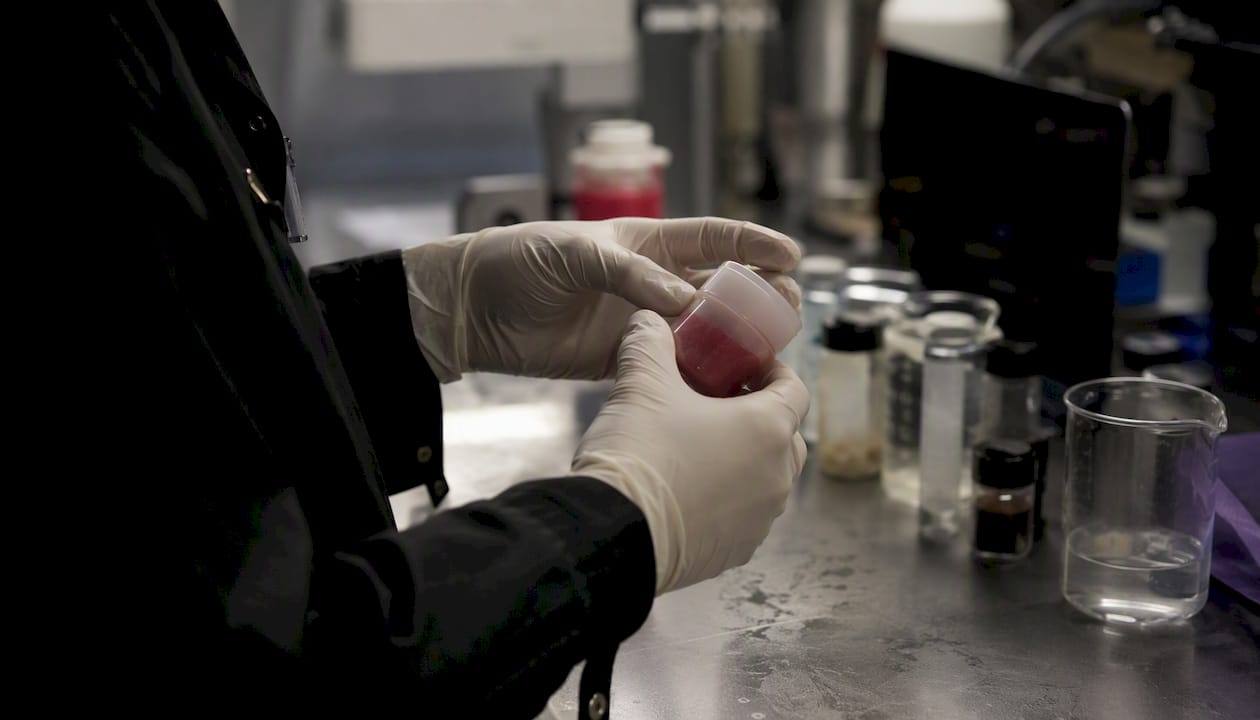
Plasticizers and softening oils keep TPE pliable, but industrial-grade mineral oils or unspecified phthalate-based plasticizers can migrate to the surface and absorb into skin over time. Colorants and black dyes are a specific concern: a peer-reviewed study on thermoplastic polymers found that one TPE sample (TPE-70ShA) produced clear cytotoxic effects while most others remained non-toxic, pointing to additives or colorants as the likely driver rather than the polymer itself.
Recycled industrial regrind is another red flag. Budget manufacturers sometimes blend virgin TPE with recycled material of unknown origin. The additive chemistry of that regrind is completely opaque.
Porosity creates a biological risk independent of chemistry. TPE’s open surface structure can trap body fluids, soap residue, and microorganisms between uses. Without thorough drying and proper storage, biofilm can develop and cause irritation or infection even when the material itself is non-toxic.
Lubricant interactions matter too. Silicone-based lubricants degrade silicone surfaces over time and can cause TPE to swell or break down. Water-based lubricants are the right choice for both materials. Oil-based lubricants accelerate surface degradation on TPE and should be avoided entirely.
- Avoid silicone-based lubricants on silicone dolls
- Avoid oil-based lubricants on TPE
- Use only water-based formulas to protect both materials
Which standards and tests actually signal safe materials
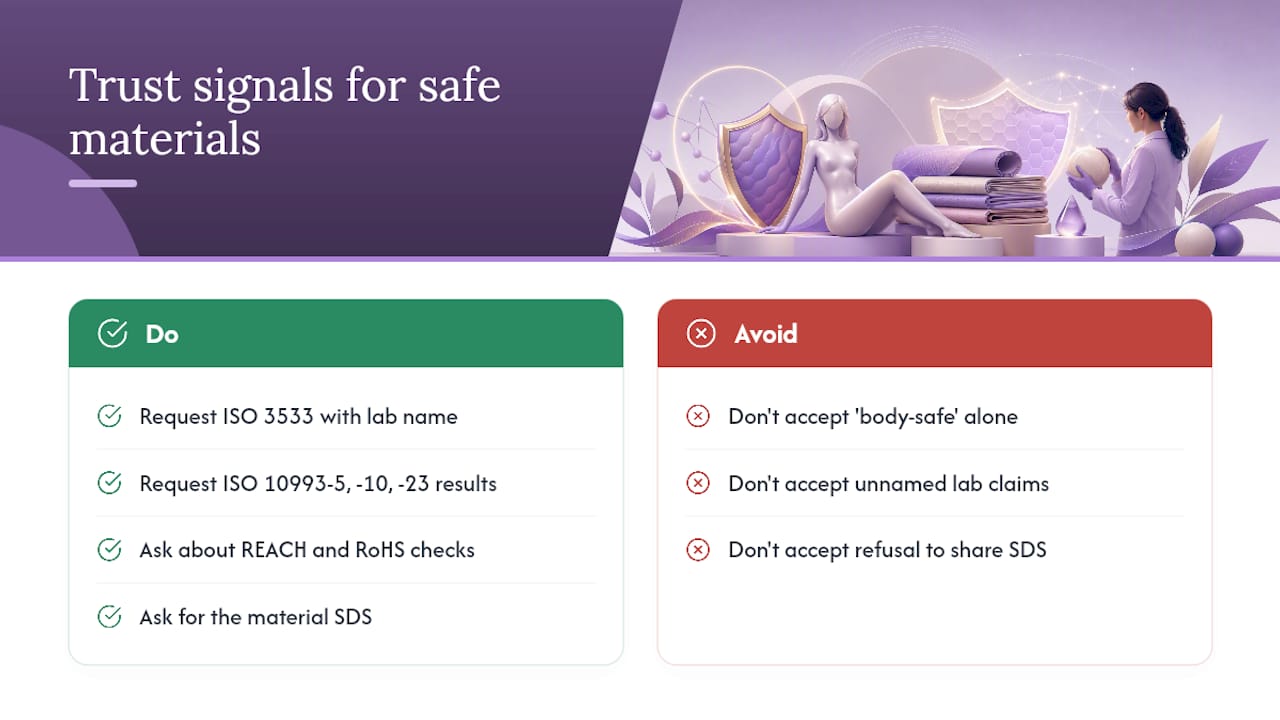
ISO 3533:2021 is the dedicated international safety standard for adult toys. It covers chemical safety, biocompatibility, mechanical risk, and user information requirements for products in direct genital or anal contact. If a manufacturer references ISO 3533 certification backed by a named third-party lab, that’s a meaningful trust signal.
ISO 10993 is the biocompatibility series used for medical devices. The tests that matter most for skin-contact products are cytotoxicity (ISO 10993-5), sensitization (ISO 10993-10), and irritation (ISO 10993-23). A manufacturer who can produce ISO 10993 test results for their specific material compound is operating at a higher standard than one who only claims “body-safe.”
SGS guidance on ISO 3533 confirms that chemical safety checks aligned with REACH and RoHS, plus third-party risk assessment, are central to the standard’s intent. REACH restricts hazardous substances in products sold in the EU; RoHS covers restricted substances in electronics but overlaps with some pigment systems. Both lists are worth asking about.
The SDS (Safety Data Sheet) is the document that lists every ingredient, its hazard classification, and safe handling instructions. Any manufacturer unwilling to share an SDS for their material compound is withholding information you have a right to see.
How to choose a safe doll: your buyer checklist
Ask these questions before you buy. Acceptable answers are specific and documented. Vague answers are red flags.
Documentation checklist:
- What is the exact material grade? (Acceptable: “platinum-cured addition-cure silicone” or “phthalate-free TPE, Shore hardness XX.” Red flag: just “TPE” or “silicone” with no further detail.)
- Can you provide the SDS for the material compound?
- Do you have third-party biocompatibility test results? (Ask for the lab name, test standard, and sample ID.)
- Is the product REACH-compliant? Can you provide documentation?
- Are colorants and pigments food-grade or cosmetic-grade?
Red flags to walk away from:
- “TPE” with no grade, hardness, or additive disclosure
- Black or dark dyes with no pigment specification
- No SDS available or “proprietary formula” as the only answer
- Price that’s implausibly low relative to comparable products
- Recycled or regrind material in the compound
Verifying certificates: check that the certificate names the issuing lab (not just the manufacturer), states the test standard and scope, and includes a sample or batch ID. A certificate without a sample ID cannot be traced to the actual product you’re buying. TPE safety in medical applications follows the same verification logic: grade and additive control, not just the polymer name, determine the outcome.
How to clean, dry, and store your doll safely
Proper care is the other half of material safety. Even a well-formulated doll becomes a hygiene risk without the right routine.
- Rinse with warm water immediately after use to remove surface residue.
- Wash with a mild, fragrance-free soap. For silicone, this is sufficient. For TPE, use an antimicrobial toy cleaner approved for porous materials if available.
- Rinse thoroughly to remove all soap. Residue left in TPE’s porous surface can cause irritation.
- Dry completely before storage. For silicone, pat dry with a lint-free cloth. For TPE, allow airflow-assisted drying for at least 30 minutes; trapped moisture is the primary driver of biofilm.
- Apply renewal powder (cornstarch or a dedicated TPE renewal powder) to TPE surfaces after drying to restore the skin-like texture and reduce tackiness that traps dust.
- Store in a cool, dry place away from direct sunlight, oils, and dust. Use a dedicated storage bag or the original packaging.
Pro Tip: Inspect TPE surfaces every few months for small tears, stickiness, or discoloration. Surface degradation accelerates additive migration and makes thorough cleaning harder. A degraded surface is a sign to replace the product.
For a full product-specific routine, Youqdoll’s cleaning and care guide covers every step in detail.
Recognizing allergic reactions and when to stop use
Most reactions are contact irritation, not true allergy. The distinction matters because irritation resolves quickly after stopping use, while sensitization can worsen with each subsequent exposure.
Watch for these symptoms:
- Redness, itching, or a rash at the contact site within hours of use
- Persistent burning or swelling that doesn’t resolve within 24 hours
- Blistering or skin breakdown (a more serious sign)
- Systemic symptoms like hives or difficulty breathing (rare but require immediate medical attention)
Immediate steps if you react:
- Stop use right away.
- Wash the affected area with mild soap and water.
- Document the product: material, lot number, SDS if available.
- If symptoms persist beyond 48 hours or worsen, consult a primary care physician or dermatologist.
Note that latex allergy is not a concern with silicone or TPE, but some individuals are sensitive to specific plasticizers or pigment systems. A dermatologist can perform targeted patch testing to identify the exact trigger.
What the research shows and where uncertainty remains
The clearest finding in current literature comes from a peer-reviewed study on thermoplastic polymers for skin-contact applications: most tested samples maintained greater than 70% metabolic activity on fibroblasts (the non-toxic threshold), but the TPE-70ShA sample showed significantly decreased metabolic activity and higher LDH release. The base polymer wasn’t the problem. Additives or colorants in that specific formulation were.
What the research doesn’t yet tell us:
- The exact additive chemistry responsible for cytotoxicity in the TPE-70ShA sample
- Long-term effects of repeated low-level additive migration in real-world use
- How degradation over months of use changes the surface chemistry of porous materials
The practical implication: generic “body-safe” marketing claims are not enough. Ask for the specific test name, the standard it was run against, and the sample ID. That’s the only way to connect a certificate to the actual material in the product you’re buying.
Why material transparency is the standard Youqdoll holds itself to
At Youqdoll, the choice to prioritize platinum-cured silicone isn’t just a marketing position. It reflects a straightforward design principle: a material whose safety profile doesn’t depend on undisclosed additives is a material you can stand behind. The craftsmanship behind Youqdoll’s dolls starts with material selection, not finish work.
Every purchase comes with discreet shipping and access to customer support for pre-sale safety questions. If you want to know what’s in the material before you buy, that’s a question Youqdoll is built to answer.
Youqdoll’s approach to documented, safe materials
Youqdoll’s silicone dolls are crafted from platinum-cured silicone, the material the Sex Doll Safety Standard 2026 identifies as the preferred option for long-term skin contact. That means a non-porous surface, no residual catalyst, and a safety profile that doesn’t shift based on undisclosed additives.

You can request SDS documentation and third-party test summaries before you buy. Youqdoll’s support team handles pre-sale safety questions directly, so you’re never left guessing about what you’re getting. The Carla 166cm silicone doll is a strong starting point if you want a full-body platinum silicone option with documented material quality. Browse Youqdoll’s silicone collection and reach out with any documentation questions before checkout.
Sources
These sources underpin the safety claims, standards, and research findings throughout this article.
- Biocompatibility of thermoplastic polymers produced by pellet extrusion for skin‑contact applications
- ISO 3533:2021 - Sex toys — Design and safety requirements for products in direct contact with genitalia, the anus, or both
- ISO 3533:2021: New International Safety Standard for Adult Toys
- Sex Doll Safety Standard 2026 - Sex Doll Scoop
This article is general information, not a substitute for advice from a qualified doctor. Consult a qualified healthcare professional about your own circumstances before acting on anything here.