

15–30 kg Is the Sweet Spot for Solo Sex Doll Owners
Most solo buyers do best between 15 and 30 kg (33 to 66 lbs), the sweet spot where a doll still feels realistic yet stays manageable without a second pair of hands. Lighter minis and torsos start under 15 kg, standard full-size dolls run 30 to 45 kg, and heavyweight silicone builds push past 45 kg. Material and skeleton design, rather than height alone, explain much of the variation in doll weight.
TL;DR:
- Dolls under 15 kg are easily manageable alone, fit in small storage spaces, and require minimal handling or staging.
- Silicone dolls typically weigh 15 to 25% more than TPE dolls of the same size, mainly due to material density differences.
- Handling heavier dolls over 30 kg requires proper techniques, staging surfaces, and sometimes two people or mechanical aids to prevent injury.
- Buyers should prioritize weight class based on storage, lifting ability, and use frequency rather than just height or appearance.
- Material build and skeleton complexity significantly influence weight, with heavier skeletons adding 5 to 12 kg and affecting poseability and handling.
Table of Contents
- Sex Doll Weight Guide: Understanding the Four Weight Classes
- How Material and Skeleton Design Change the Number on the Scale
- Handling, Cleaning, and Storage by Weight Class
- Choosing the Right Weight: A Buyer’s Checklist
- Weight Considerations Beyond the Standard Size Classes
- Portability Versus Stability: The Real Trade-Off
- Matching Weight to Poseability and Purpose
- Safety and Injury Prevention With Heavier Dolls
- What Ownership Actually Teaches You About Weight
- Find Your Weight Class in the YouQDoll Lineup
- Sources
Sex Doll Weight Guide: Understanding the Four Weight Classes
Spec sheets list height and cup size. They rarely tell you what a doll feels like to drag out of a closet at midnight. That gap is exactly why a proper weight guide matters more than a height chart.
Ownership patterns split cleanly into four bands, and each one changes how often the doll actually gets used, based on handling and storage guidance tied to weight class.
- Under 15 kg (mini/torso class): One-arm lift, no staging needed, fits in a closet shelf or under-bed bin. Cleaning happens at the sink.
- 15 to 30 kg (small/standard class): Manageable solo with a proper grip, best moved with a sheet-drag technique. Storage needs a dedicated space, like a wardrobe or reinforced shelf.
- 30 to 45 kg (full-size class): Realistic weight distribution but a genuine workout to reposition. Most owners set up a fixed spot near the bed or bathroom to avoid repeated carries.
- 45 kg and up (heavyweight class): Feels close to moving another adult. Two-person handling is common, and storage almost always requires a hoist, low platform, or wheeled base.
A buyer in a studio apartment with limited storage usually regrets going past 30 kg, no matter how much the extra realism appealed to them at checkout. The cost trade-off runs both ways: heavier dolls cost more in shipping and often need reinforced furniture, while lighter classes save money but sacrifice some jointed realism.
How Material and Skeleton Design Change the Number on the Scale
Two dolls at 165 cm can differ by 15 pounds or more, and the culprit is almost never the mold. It’s the material and the skeleton inside it.
TPE runs roughly 0.88 to 0.96 g/cm³ in density, while silicone sits closer to 1.1 to 1.3 g/cm³. That difference means silicone dolls typically weigh 15 to 25% more than TPE dolls of identical dimensions, a gap that shows up the moment you try to shift one on a bed frame. A 160 cm TPE doll often lands around 26 to 30 kg, while the same mold in silicone can climb to 32 to 38 kg.
Density snapshot: TPE ≈ 0.88–0.96 g/cm³. Silicone ≈ 1.1–1.3 g/cm³. Same height, meaningfully different armful.
The internal skeleton adds its own weight on top of the shell. A stainless-steel posable frame can contribute 5 to 12 kg on its own, and that number climbs with every extra joint. More posable fingers, a multi-joint spine, or articulated ankles all add incremental mass, which is the trade buyers make for a doll that holds a pose realistically.
Before buying, ask the seller for three specific figures:
- Total shipped weight
- Skeleton weight alone
- Headless or base body weight without accessories
A seller who can’t answer those questions probably hasn’t weighed the product carefully, which also tells you something about their attention to detail elsewhere.
Handling, Cleaning, and Storage by Weight Class
Lifting technique matters more than raw strength once you cross 20 kg. Below that, most adults manage solo lifts without much thought. Between 20 and 35 kg, a straight-back lift with knees bent becomes necessary, and past 40 kg, a second person or a mechanical aid stops being optional for most people.
Here’s a workflow that keeps repeated lifting to a minimum, adapted from practical ownership tactics for moving heavier dolls safely:
- Build a staging surface at bed height near the storage spot, so you never lift from floor level.
- Use the sheet-drag method for anything over 20 kg: slide the doll onto a folded sheet and pull rather than carry.
- Keep the storage location close to the use location. A doll stored in another room adds a full carry cycle every single use.
- Add casters or a rolling trolley for dolls over 30 kg so you slide instead of lift entirely.
- Clean in place when possible. Wipe down with a damp cloth on the staging surface rather than hauling the doll to a shower for routine maintenance.
Pro Tip: Keep a small caddy of cleaning supplies right next to the storage spot. Every extra trip to fetch soap or a towel is another chance to strain your back on a doll over 30 kg.
For deeper maintenance, a full cleaning and care routine cuts down on how often you need to move the doll for a proper wash, and reinforced storage options like the ones covered in discreet storage solutions solve the “where does this even go” problem before it becomes a daily annoyance.
Choosing the Right Weight: A Buyer’s Checklist
Match the doll to your actual living situation, not your ideal one. A doll that sits unused in a closet because it’s too heavy to move isn’t realistic. It’s dead weight, literally.
Run through this before you buy:
- Space: Do you have a dedicated storage spot, or are you working around a shared closet?
- Lifting ability: Can you comfortably lift 25 to 30 kg alone, or do you need a partner or trolley?
- Storage plan: Reinforced shelf, wardrobe, or hanging solution — pick one before the doll arrives.
- Cleaning plan: In-situ wipe-downs or full showers, and how often realistically.
- Frequency goal: Daily use favors lighter classes; occasional use tolerates more weight.
- Realism preference: How much does jointed posability and body heft matter to you personally?
Manufacturer guidance backs a practical ceiling here: dolls under 25 kg handle easily, the 25 to 45 kg range adds realism at the cost of needing a real storage and cleaning plan, and anything past 45 kg calls for genuine two-person logistics.
Before you check out, get exact answers from the seller: total weight, skeleton weight, material density if listed, and packed shipping weight. A supplier checklist helps you know exactly what to ask before money changes hands.
Weight Considerations Beyond the Standard Size Classes
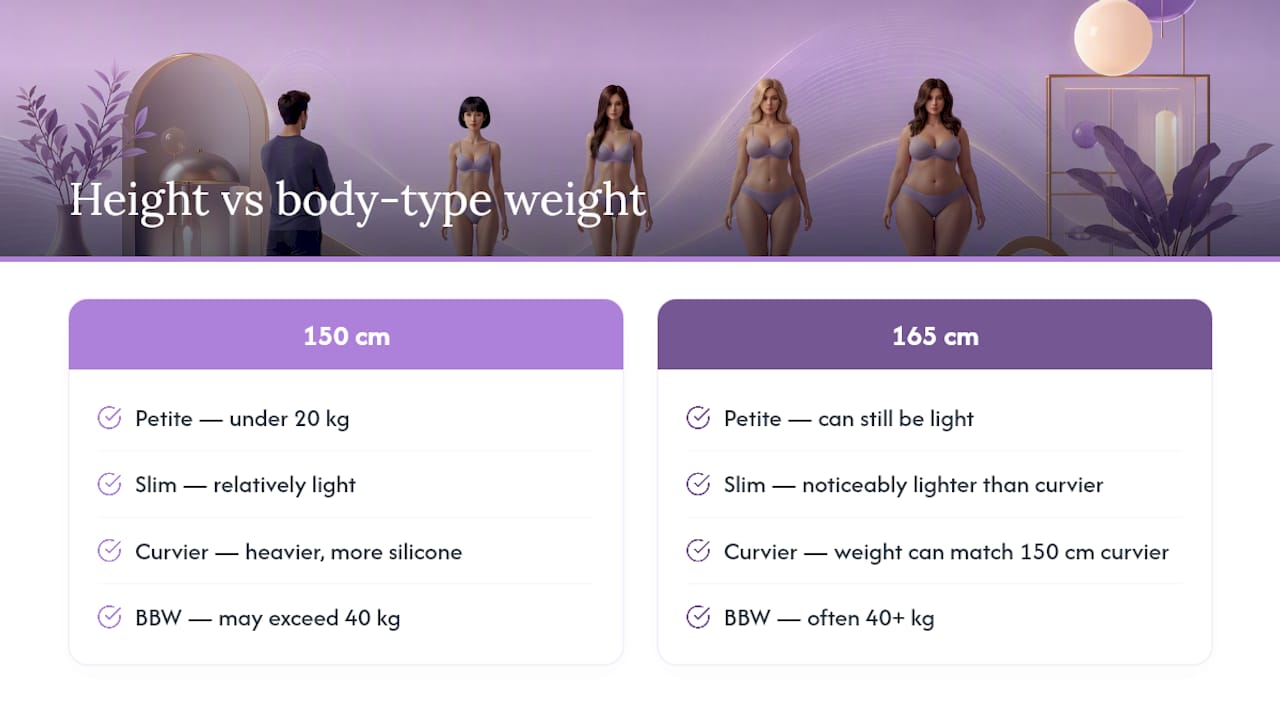
Height and weight class don’t always move together, and that trips people up more than it should. A petite 150 cm doll built with a full metal skeleton and a curvier body type can weigh close to what a taller, slimmer 165 cm doll weighs. Body type, not just height, drives a big chunk of the number.
Curvier builds with more silicone mass in the hips, chest, and thighs add pounds independent of height. A slim, athletic mold of the same height can weigh noticeably less because there’s simply less material distributed across the frame. If realism in body shape matters more to you than raw height, expect the weight to track the curve profile rather than the tape measure.
Petite or “younger-looking” body types marketed at shorter heights often use lighter skeletons to match proportional expectations, which can put them well under 20 kg even in silicone. Meanwhile, BBW or plus-size body types can push standard-height dolls into the 40+ kg range because of how much additional material fills out the mold.
The practical takeaway: always check the specific listed weight for the exact body type and mold you’re considering, not a generalized average for that height. Two dolls at the same listed height can land in completely different weight classes depending on build.
Portability Versus Stability: The Real Trade-Off
Every kilogram you add buys you something and costs you something else. That’s the honest version of the portability versus stability debate, and it’s worth thinking through before you fall for a listing photo.
Lighter dolls under 20 kg are easy to reposition, store, and travel with if that’s part of your plan. They’re also more prone to tipping or shifting during use because there’s less mass anchoring the frame in place. A torso or mini in this range moves like a cushion. Convenient, but it won’t hold a pose against much resistance.
Heavier dolls in the 30 to 45 kg range plant themselves. Once positioned, they stay positioned, which is exactly why serious posability fans gravitate toward that range despite the handling cost. The added mass acts like ballast, giving the frame the stability to hold weight-bearing poses that a lighter build simply can’t sustain.
There’s no version of this where you get maximum stability and maximum portability at the same time. Buyers who want both usually end up disappointed with whichever end of the scale they picked, because they were optimizing for the wrong variable. Decide which one actually matters for how you’ll use the doll, then let that decision drive the weight class you shop in.
Matching Weight to Poseability and Purpose
Weight and poseability are linked by the skeleton, not by coincidence. If holding specific poses matters to you, the joint count and skeleton weight matter more than the overall number on the scale.
A doll built for standing poses or dynamic positioning needs a denser skeleton with more load-bearing joints, and that skeleton adds real mass, typically that 5 to 12 kg range on top of the shell weight. If your priority is a doll that holds a seated or reclined position without much adjustment, a lighter skeleton with fewer joints does the job with less overall weight to manage.
Buyers focused purely on aesthetics and light handling, rather than elaborate posing, are usually better served by the lighter end of the 15 to 30 kg range. You get the visual realism without paying the weight penalty for joint articulation you won’t use much anyway. Buyers who care about photography, varied positioning, or a wider range of physical interaction should expect to trade some of that manageability for a heavier, more capable frame.
Think of it as buying for the use case, not the spec sheet. A doll that photographs beautifully in twelve poses but never leaves the corner of the room because it’s too heavy to reposition isn’t serving its purpose.
Safety and Injury Prevention With Heavier Dolls
Back strain is the most common complaint among owners of dolls over 35 kg, and it’s almost always preventable with better technique rather than more strength. The mechanics of lifting an unevenly weighted, awkwardly shaped object are genuinely different from lifting a gym weight, which is why so many people get hurt on their first attempt.
Bend at the knees, not the waist, and keep the doll’s mass close to your body rather than extended at arm’s length. The sheet-drag method mentioned earlier isn’t just about convenience. It removes the lift entirely for the riskiest part of any move, the initial transition from a flat surface to an upright position.

If you’re working with anything past 40 kg, treat every move like a two-person job until you’ve proven to yourself otherwise. Dropping a heavy doll doesn’t just risk your back. It risks the doll’s joints and skin, which are far more expensive to repair than a moving strategy is to plan.
Storage height matters too. A doll stored on a high shelf forces an overhead lift on the way down, which is one of the worst positions for lower-back strain regardless of how strong you are. Keep heavier dolls at or near hip height in storage, and you eliminate the single riskiest motion in the entire ownership routine.
What Ownership Actually Teaches You About Weight
Buyers chase realism first and logistics never. That’s the pattern I keep seeing, and it’s backward. Weight matters more for long-term satisfaction than almost any other spec, because a heavy doll without a handling plan quietly turns into a doll that sits unused, according to ownership data linking weight to actual usage frequency.
The mistake is buying at the top of your strength ceiling on day one. A first-time buyer who starts with a torso or mini learns their own habits, storage quirks, and cleaning routine before committing to 35+ kg of silicone. That sequencing matters more than most buyers expect going in.
Material upgrades carry a hidden cost too.
— Alfie
Find Your Weight Class in the YouQDoll Lineup
Once you know your ideal weight band, matching it to an actual product gets simple. The range on the market covers every class in this guide, so you’re not guessing whether “full-size” means 28 kg or 42 kg.

For apartment living or a first purchase, a compact torso like the Vivienne silicone torso or a petite build like the 75cm CC mini sits comfortably under 15 kg with zero storage hassle. Buyers wanting more presence without the heaviest handling burden do well with a TPE build like Dottie at 160 cm, which lands in that manageable 15 to 30 kg sweet spot. If full silicone realism is the priority and you’ve planned your storage and lifting routine accordingly, a midweight model like the Scarlett 166cm silicone doll delivers the density and pose stability that lighter materials can’t match.
Most listings state total weight and skeleton weight up front, and customization options often let you choose material and skeleton complexity to control the final number yourself. Browse the full collection and filter by the weight class that actually fits your space before you fall for a photo instead of a spec sheet.
Sources
- Sex Doll Weight Guide: Pounds Matter More Than Inches
- How to Choose the Right Size and Weight for Your Sex Doll – RosemaryDoll Help Center